
5 Fire Extinguisher colours and 5 agents, what is each for!
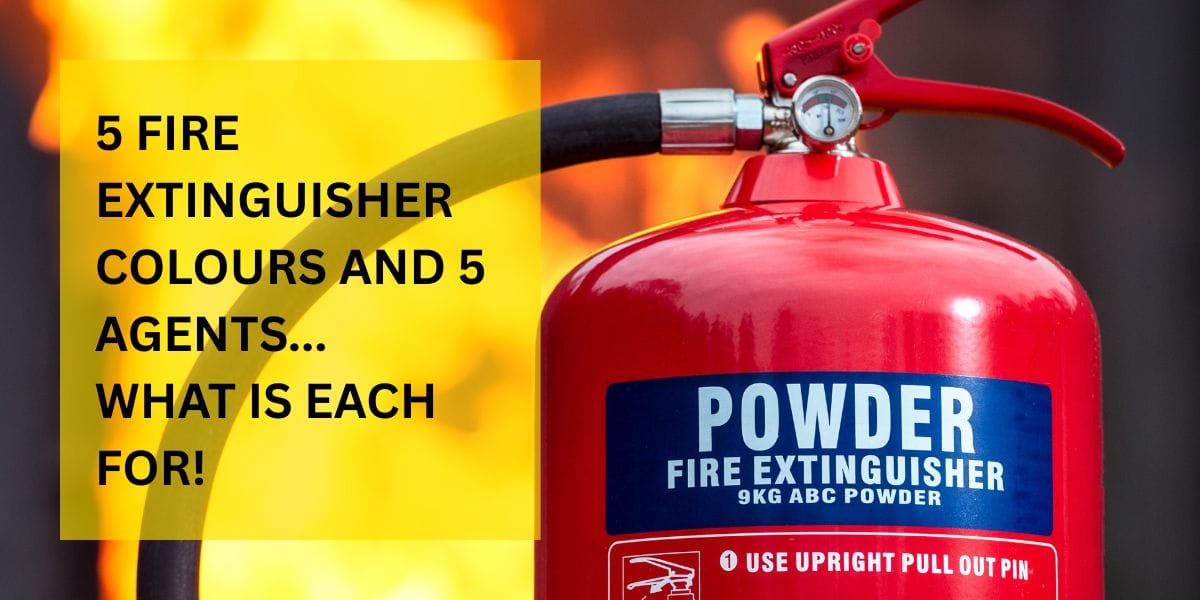
A small fire breaks out near your electrical switchgear. Someone grabs the nearest extinguisher and lets it off. Wrong type. The situation gets worse, not better. Nobody checked the colour-coded label that would have told them in two seconds whether that extinguisher was safe to use on that fire. This is precisely what fire extinguisher colours are used for!
We see this kind of confusion regularly. Businesses have fire extinguishers on the wall that came with the building, left by the previous tenant, and nobody has checked whether they actually match the fire risks on site. The colour band on each extinguisher is there for a reason. It tells you exactly what agent is inside and which fires it can tackle safely.
Here is how the system works, what each fire extinguisher colour means in the UK, and what you actually need to know as the person responsible for your premises.
Five Colours, Five Agent Types - Here Is What You Are Looking At
Every portable fire extinguisher sold in the UK must have a red body. That is not optional. Under BS EN 3, at least 95% of the body has to be Signal Red (RAL 3000). The agent type is shown by a coloured band or panel on the upper body, covering roughly 5-10% of the surface. There is no such thing as an all-blue or all-black extinguisher in the UK.
Here are the five main types and their colour labels:
- Water - all red, no separate colour band. The body is entirely red with no additional panel. If it is all red, it is water. Class A solid-material fires only.
- Foam (AFFF) - cream band. Tackles both Class A solids and Class B flammable liquids. A versatile choice for premises with mixed risks.
- CO2 (carbon dioxide) - black band. The go-to for server rooms, electrical panels and anywhere you need residue-free suppression. Rated for Class B and electrical fires. Not effective on Class A solid-material fires.
- Dry powder (ABC) - blue band. Technically covers Class A, B and C fires plus electrical. But there is a catch - BS 5306-8:2023 says dry powder should not be used indoors unless a risk assessment justifies it. The powder cloud wrecks visibility and creates inhalation risks. Better suited to outdoor or vehicle use.
- Wet chemical - yellow band. The correct choice for commercial kitchens and anywhere with deep fat fryers. Rated for Class F cooking oil fires and Class A solids.
A sixth type - water mist - carries a white band. These are increasingly common for mixed-risk environments. Models that have been di-electrically tested to 35 kV under BS EN 3 can be used near electrical equipment up to 1,000 V, provided they carry the electrical safety rating.
One point we always flag with clients: CO2 extinguishers have a black label, not a blue one. Dry powder has the blue label. Confusing the two is a dangerous mistake, and it happens more often than you would think.

UK Fire Classes - Not the Same as the US System
If you have ever looked up fire extinguisher guidance online, there is a good chance some of it was written for the American market. The UK uses a completely different classification system based on the European standard BS EN 2. Getting the two mixed up leads to real confusion, so here is what applies in the UK:
- Class A - Solid combustible materials. Wood, paper, cardboard, textiles, plastics. The most common class in offices, warehouses, schools and retail.
- Class B - Flammable liquids. Petrol, diesel, paint, solvents, oil-based products. Relevant wherever flammable liquids are stored or used.
- Class C - Flammable gases. Propane, butane, methane, natural gas. The standard approach for gas fires is to isolate the supply if safe to do so, not tackle it with a portable extinguisher.
- Class D - Combustible metals. Lithium, magnesium, sodium, aluminium swarf. Specialist risk found in manufacturing or battery storage. Standard extinguishers do not work on these - you need specialist agents like M28 or L2 powder, specified by a competent person who understands the specific metal fire risk.
- Class F - Cooking oils and fats. Deep fat fryers, chip pans, commercial catering equipment. Burning cooking oil behaves differently from Class B flammable liquids and needs a different suppression method - that is where wet chemical extinguishers come in.
One thing that catches people out: electrical fires are not a separate class in the UK. There is no Class E. When an electrical fault starts a fire, the fire itself is classified by whatever material is burning. Whether an extinguisher can be used safely near live electrical equipment is shown by an electric spark symbol on the label, not a letter class.
Choosing the Right Extinguishers for Your Premises
The Regulatory Reform (Fire Safety) Order 2005 requires the Responsible Person to carry out a fire risk assessment (Article 9). Based on that assessment, Article 13 requires appropriate firefighting equipment where necessary. The FSO does not specify types or quantities - those specifics come from BS 5306-8:2023.
Here is what BS 5306-8:2023 recommends as a minimum:
- Two Class A rated extinguishers per storey, with an aggregate rating of at least 26A.
- Premises under 50 m² may be covered by a single extinguisher - a provision introduced in the 2023 edition.
- Class B flammable liquid extinguishers positioned no more than 10 metres from the hazard.
- Wet chemical extinguishers positioned near cooking appliances for Class F risks.
- Maximum travel distance to a Class A extinguisher: 30 metres from any point in the premises.
Beyond the minimum, the right mix depends on what risks are actually present on your site. What materials are stored, what processes are carried out, what equipment is in use. A single extinguisher type rarely covers every credible fire scenario in anything other than the simplest premises.
This is where a proper assessment matters. When we take over fire extinguisher maintenance for a site, our engineers check the existing provision against the actual risks identified in your fire risk assessment - not just what the previous occupant left behind. Our engineers all complete the four-day FIA-approved extinguisher servicing course, so they know what should be there and what should not.
Where to Put Them
Having the right extinguishers means nothing if nobody can find them when it matters. BS 5306-8:2023 is just as specific about positioning as it is about selection.
Wall-mount them. Extinguishers should be on appropriate brackets, not left free-standing on the floor where they get knocked over, hidden behind boxes or simply forgotten about.
Get the height right. For units up to 4 kg total mass, the handle should sit at roughly 1.5 metres from the floor. Heavier units go at roughly 1.0 metre. These heights mean the extinguisher can be lifted and operated safely under pressure.
Position them on exit routes and near identified hazards. The aim is simple: nobody should be running more than 30 metres to reach a Class A extinguisher. In larger or more complex premises, signage above mounting points helps people find them fast.
In kitchens, position the wet chemical extinguisher close to the cooking equipment - but not so close that a fire at the fryer blocks access to it. Near enough to reach in seconds, far enough that the hazard is not in the way.
Maintaining Your Extinguishers - What the Law Actually Requires
Article 17 of the FSO 2005 places a legal duty on the Responsible Person to maintain firefighting equipment in efficient working order. The recognised framework for meeting that duty is BS 5306-3:2017. This is what fire and rescue authority inspectors check against when they assess compliance.
There are four parts to the maintenance regime:
Monthly visual inspections - These are your responsibility, not your contractor's. A nominated person on site checks each extinguisher is in position, accessible, undamaged, with the pressure gauge in the green zone, tamper seal intact and instructions legible. Record the date and outcome each time.
Annual basic service - Carried out by a competent person. This means a full external examination, pressure and weight checks, component and seal inspection, and a new service label. Our FIA-trained engineers complete this within a 12-month window of the previous service date, in line with BS 5306-3.
Extended service at five-year intervals - Applies to water, foam, powder and wet chemical units. This involves test discharge, internal inspection, component replacement and refilling. At this stage it is often more cost-effective to replace the unit than service it - we will tell you straight which option makes more sense for your situation.
CO2 overhaul at ten-year intervals - Hydraulic pressure testing of the cylinder. No extinguisher of any type should remain in service beyond 20 years from manufacture.
We coordinate extinguisher servicing with fire alarm maintenance and emergency lighting testing wherever possible. One visit covers everything, which means less disruption for you and nothing slipping through the cracks because different contractors are working to different schedules.
Watch Out for US-Sourced Guidance
This is worth saying clearly: a lot of fire extinguisher content online is written for the American market. Different fire classes, different colour conventions, imperial distances, and a completely different legislative framework. If you are managing a UK commercial premises, US-sourced guidance is not just unhelpful - it is actively misleading.
In the UK, your obligations sit under the FSO 2005. Your technical standards are BS EN 3 for the extinguishers themselves, BS 5306-8:2023 for selection and positioning, and BS 5306-3:2017 for maintenance. That is the framework that matters.
Three Things to Check This Week
- Match your extinguishers to your actual fire risks. Check the types on your walls against the risks identified in your fire risk assessment. Not what came with the building - what your premises actually need right now.
- Confirm your maintenance is up to date. Annual servicing should be carried out by engineers with proper extinguisher training. Ask when your units are due for extended service or CO2 overhaul - these get missed more often than you would expect.
- Start doing monthly visual checks if you are not already. This is a Responsible Person obligation under Article 17 of the FSO 2005. It does not wait for the annual engineer visit. Nominate someone, give them a checklist, and make sure it gets recorded.
If you are not sure whether your current extinguisher provision matches your risks, or if your maintenance has lapsed, get in touch. We will take a look at what you have got, tell you honestly what needs changing, and give you a clear price with no surprises. That is how we work - for over 100 Amber Taverns pubs, for council buildings, for academy trusts, and for businesses of every size across the UK.

Although we make reasonable efforts to update the information on our site, we make no representations, warranties or guarantees, whether express or implied, that the content on our site is accurate, complete or up to date.